
At some point, most people look around their homes and realize they own far more than they need. This article is a primer on decluttering tips to help you get started.
Closets are packed. Garages are overflowing. Spare bedrooms become storage rooms. Drawers contain items that haven’t been used in years. What started as a few possessions accumulated over decades can eventually become a burden that consumes space, time, and energy.
Yet even when we recognize that we need to declutter, letting go of possessions is often easier said than done.
Many people struggle because every item seems tied to a memory, a future possibility, or the feeling that it might be useful someday. As a result, clutter continues to grow while peace of mind slowly disappears.
The good news is that decluttering does not require becoming a minimalist or throwing away everything you own. The goal is simply to create a home that supports your life instead of overwhelming it.
Learning how to let go of possessions without regret is one of the most valuable skills you can develop, especially after 50, when priorities often begin to shift toward freedom, simplicity, and meaningful experiences.
Why Letting Go Feels So Difficult
If decluttering were simply about getting rid of things, everyone would have an organized home.
The real challenge is emotional attachment.
Many possessions represent memories, achievements, relationships, or important chapters of our lives. A box of old photographs can remind us of family vacations. A collection of tools may represent years of hard work. Clothing from a previous stage of life can trigger memories of who we once were.
Even items with little practical value can carry emotional significance, which is why having some realistic decluttering tips is important.
There is also the belief that we may need something someday. This mindset often leads people to keep items “just in case,” even when they have not used them for years.
Understanding that these feelings are normal is an important first step. You are not simply sorting objects. You are making decisions about what role those objects will continue to play in your future.
The Difference Between Memories and Possessions
One of the most powerful mindset shifts in the decluttering process is recognizing that memories are not stored in objects.
The object may remind you of a memory, but the memory itself lives within you.
Many people keep boxes of items they rarely look at because they fear losing the memories attached to them. In reality, the memory often remains even after the item is gone.
Consider family vacations. You probably remember many of them without keeping every brochure, ticket stub, or souvenir.
The same principle applies to many sentimental possessions.
Keeping a few meaningful reminders can make sense. Keeping everything often creates clutter without adding value.
When evaluating sentimental items, ask yourself whether the object truly enriches your life or simply occupies space.
Start With Easy Decisions
One of the biggest mistakes people make is starting with their most emotional possessions.
Family heirlooms, old photographs, and childhood keepsakes are often the most difficult categories to sort through.
Instead, begin with items that have little emotional attachment.
Expired products, broken appliances, duplicate kitchen tools, worn-out clothing, old magazines, and outdated electronics are usually easier decisions.
These early wins build momentum and confidence.
As you begin to see progress, your ability to make more difficult decisions improves.
Decluttering is a skill, and like any skill, it becomes easier with practice.
Focus on Your Future, Not Your Past
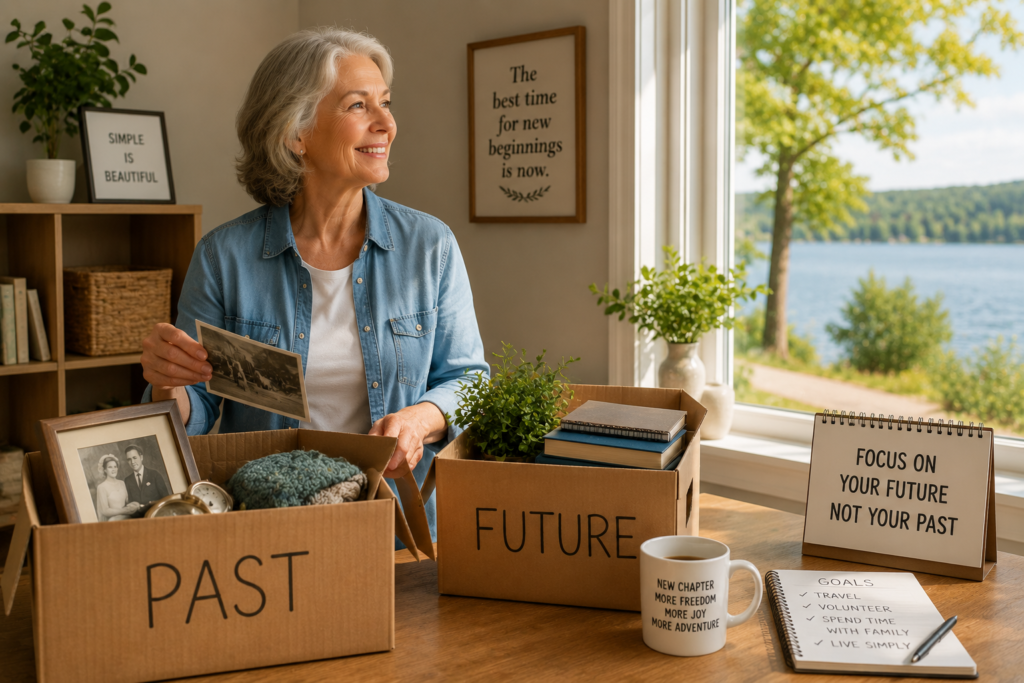
Many people evaluate possessions based entirely on their past.
Where did this come from?
Who gave it to me?
How much did I pay for it?
What memory is attached to it?
While these questions are understandable, they often make decluttering harder.
A more helpful question is this:
“Does this item support the life I want moving forward?”
This simple shift can be transformative.
Instead of focusing on what an item meant years ago, you focus on whether it serves your current goals and lifestyle.
If your goal is greater freedom, less stress, easier travel, or a simpler home, your possessions should support those goals.
Items that no longer fit your future may no longer deserve space in your present.
The Cost of Keeping Too Much
Most people focus on the cost of getting rid of something.
They rarely consider the cost of keeping it.
Every possession occupies physical space.
Every possession requires storage.
Every possession demands some amount of attention.
The more items you own, the more time you spend cleaning, organizing, moving, maintaining, and managing them.
Clutter can also create mental stress.
Studies have shown that cluttered environments often contribute to feelings of anxiety, distraction, and overwhelm.
When evaluating an item, consider what it is costing you to keep it.
Sometimes the hidden costs are greater than the benefits.
Avoid the “Just in Case” Trap
One of the most common causes of clutter is the belief that an item might be useful someday.
While keeping certain emergency supplies makes sense, many homes contain hundreds of items being stored for hypothetical future situations that never occur.
That exercise equipment you haven’t used in eight years.
The box of cables for electronics you no longer own.
The spare appliance that has sat untouched in the garage for a decade.
The clothing that no longer fits but might someday.
The question is not whether you could possibly use it again.
The question is whether it is likely enough to justify the space it occupies.
In many cases, the answer is no.
Use the Container Method
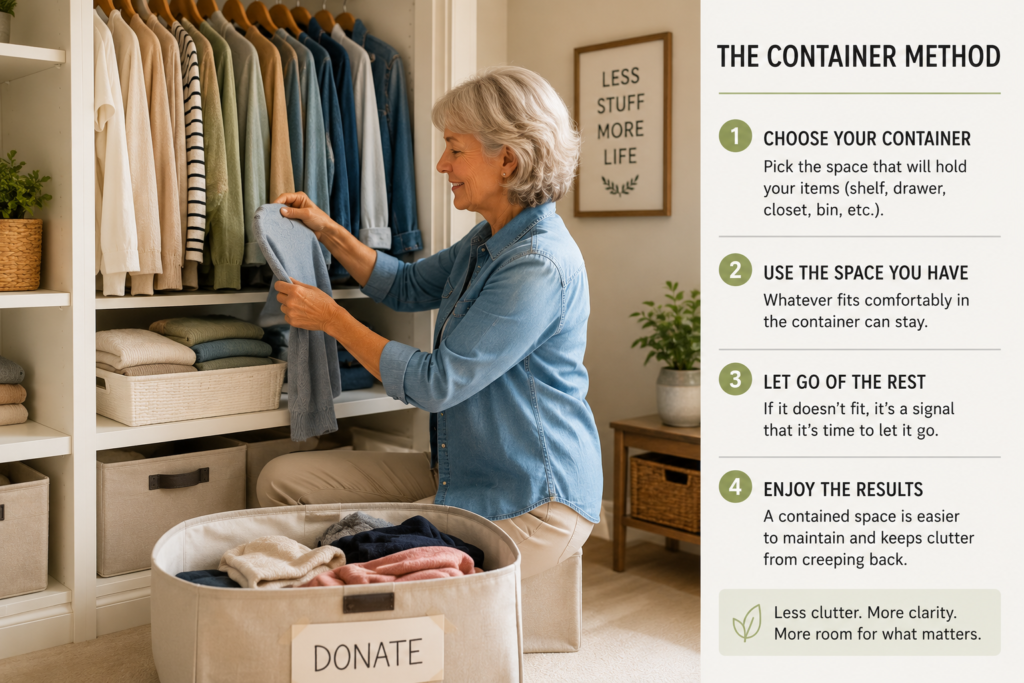
A helpful decluttering strategy comes from organizing expert Dana K. White.
Instead of asking how much stuff you can keep, ask how much space you have available.
For example, if you have one bookshelf, the bookshelf becomes the container.
Only the books that fit comfortably on that shelf stay.
The same principle applies to closets, cabinets, storage bins, and drawers.
The container determines the limit.
This approach reduces decision fatigue and helps prevent clutter from expanding indefinitely.
Let Go of Guilt
Guilt is one of the biggest obstacles to successful decluttering.
People often keep gifts they never use because they feel guilty letting them go.
Others keep expensive items because they spent good money on them years ago.
Some hold onto inherited possessions because they feel obligated to preserve everything.
The reality is that the purpose of a gift was fulfilled when it was given.
The money spent on an item is already gone.
Keeping something out of guilt does not honor the item or the person associated with it.
Your home should serve your current life, not function as a storage facility for guilt.
Create a Memory Box
For sentimental items, a memory box can be an excellent solution.
Choose a single container dedicated to your most meaningful keepsakes.
Photographs, letters, small heirlooms, awards, and special mementos can be preserved without taking over your entire home.
Limiting yourself to one container encourages thoughtful choices about what truly matters.
Many people discover that a small collection of treasured items provides greater satisfaction than dozens of boxes stored out of sight.
Progress Beats Perfection
One reason people abandon decluttering projects is that they expect perfection.
They believe they need to organize their entire home in a weekend.
That expectation often leads to frustration and burnout.
A better approach is consistent progress.
One drawer today.
One shelf tomorrow.
One closet next week.
Small efforts accumulate surprisingly quickly.
Over time, those small improvements create dramatic results.
Remember that decluttering is not a destination. It is an ongoing process of making intentional choices about what belongs in your life.
The Freedom That Comes From Owning Less

Many people begin decluttering because they want a cleaner home.
What they often discover is something much more valuable.
They gain freedom.
Freedom from constantly managing possessions.
Freedom from clutter-induced stress.
Freedom from maintaining items they no longer need.
Freedom to spend their time, money, and energy on things that truly matter.
The goal is not to own as little as possible.
The goal is to own the right things.
When your possessions support your lifestyle instead of controlling it, life often feels lighter, simpler, and more enjoyable.
Final Thoughts
Learning how to let go of possessions without regret is not about getting rid of everything.
It is about making thoughtful decisions about what deserves space in your home and your life.
Start small.
Focus on progress.
Keep what serves a purpose or brings genuine joy.
Release what no longer aligns with the life you want moving forward.
Over time, you may discover that the things you gain from using these decluttering tips, including peace of mind, freedom, simplicity, and clarity, are worth far more than the possessions you leave behind.
The journey toward a simpler life begins with a single decision.
And that decision can start today.