My cargo trailer camper build hasn’t been moving as quickly as I might have hoped lately, but that doesn’t mean it hasn’t been moving forward.
If you’ve followed my earlier posts, you know that I’ve intentionally tried not to rush this project. I want a simple, practical cargo trailer camper that works for the way I plan to travel, not something filled with unnecessary features just because other camper builds have them.
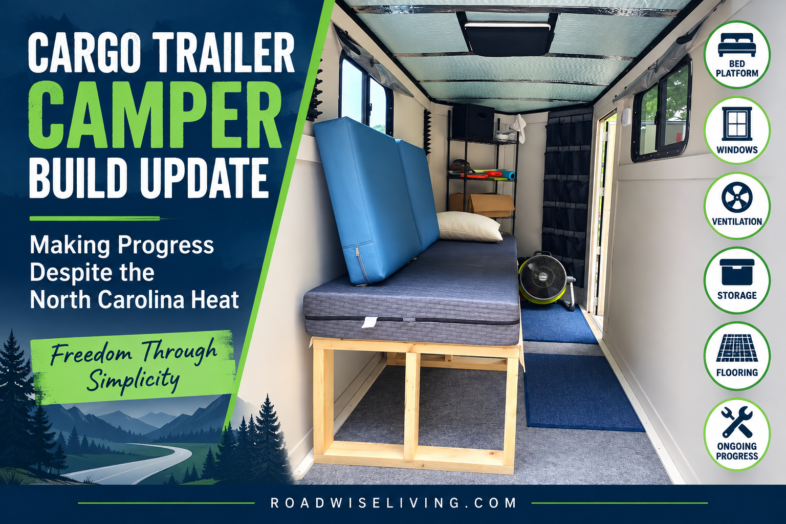
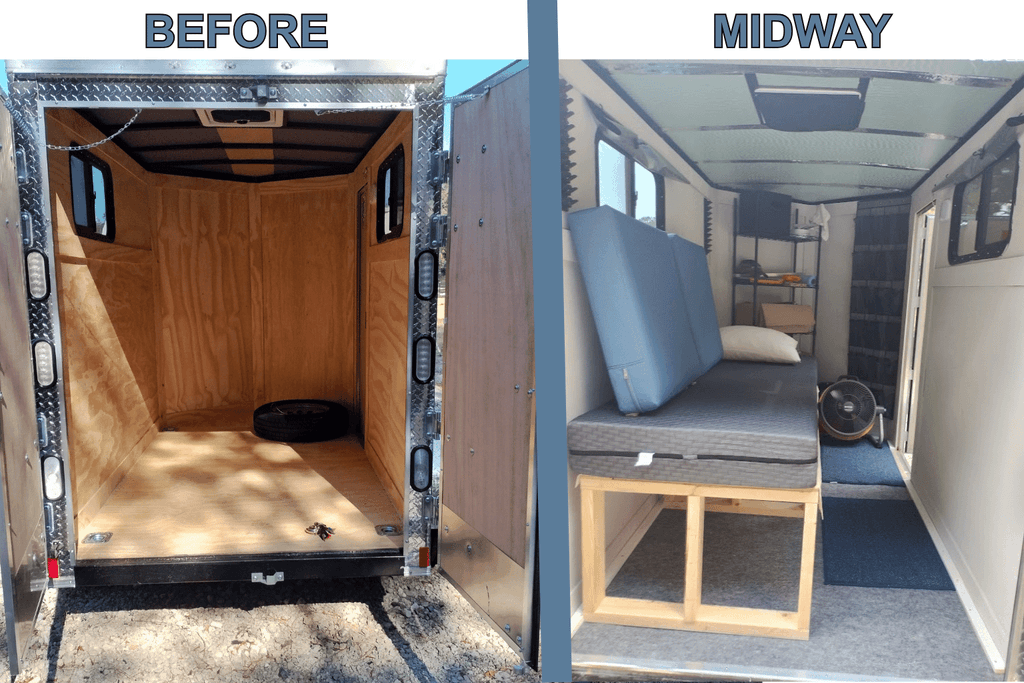
Over the past several weeks, I’ve made some noticeable improvements to the interior. As you can see from the latest photo, it is finally starting to look and feel much more like a small camper.
The biggest obstacle hasn’t been a lack of motivation or things to do.
It has been the North Carolina heat.
Working Around the North Carolina Summer Heat
One thing I underestimated when planning this cargo trailer camper build was just how difficult it can be to work inside a cargo trailer during hot weather.
Even with the doors and windows open and a fan running, a small enclosed trailer can become uncomfortable very quickly once the sun starts heating the exterior.
Because of that, most of my productive work has been limited to cooler days or a few hours early in the morning.
I might get outside early, accomplish one or two things, and then call it a day once the temperature inside the trailer becomes uncomfortable.
And I’ve decided that’s perfectly fine.
This project isn’t a race.
I’d rather make a little progress at a time than push myself through extreme heat simply because I have a departure date on the calendar.
The Bed Platform Inside the Cargo Trailer Camper Build Is Taking Shape
One of the most obvious changes is the bed.
My original plans for the bed evolved after I realized that the metal bed frame I had purchased wasn’t going to give me the storage arrangement I wanted underneath it.
That’s one of those lessons you sometimes don’t learn until you actually start putting things together.
Instead of trying to force the original plan to work, I decided to build a wooden bed platform that better fits the trailer and my needs.
The new platform gives me a solid sleeping area along the driver’s side of the trailer while preserving valuable space underneath.
In a 5×8 cargo trailer, that space matters.
There simply isn’t enough room to waste several square feet because something was designed poorly.
The bed now occupies one side of the trailer while leaving a surprisingly usable walkway down the other side.
That was important to me because I don’t want the trailer to feel so crowded that simply getting in and out becomes a chore.
It’s Starting to Look Like a Place I Can Actually Live In
This may be the biggest change of all.
For a long time, I looked inside the trailer and saw a construction project.
Now I’m beginning to see a camper.
The mattress is in place. The bed platform is built. The windows bring in natural light. The insulated ceiling is installed. The roof vent provides additional ventilation. Flooring makes the interior feel more finished, and I have begun experimenting with storage and organization toward the front of the trailer.
None of these things seem dramatic on their own.
Together, however, they completely change the space.
That’s something I’ve learned during this conversion: small improvements begin adding up surprisingly quickly.
One weekend you install a window.
Another morning you work on the bed.
Later you add flooring, insulation, storage, or ventilation.
Eventually you look inside and realize the empty cargo box you started with is disappearing.
I’m Testing the Cargo Trailer Camper Build Layout Before Making Everything Permanent
You’ll also notice that the trailer doesn’t look like a professionally finished RV interior.
That’s intentional.
I’m still figuring out exactly where I want things.
Rather than permanently attaching cabinets, counters, and storage systems everywhere, I’m trying to leave myself room to make changes.
I want to actually use the trailer and discover what works.
For example, where should frequently used items be stored?
How much room do I really need for cooking?
Where will the cooler/refrigerator work best?
What needs to be accessible from the bed?
Which things should stay in the RAV4 instead of taking up valuable trailer space?
Those questions are much easier to answer after spending time inside the trailer than they are while sitting at a desk drawing plans.
My goal isn’t to build the most impressive cargo trailer camper.
My goal is to build one that works.
Ventilation Has Become Even More Important
Working inside the trailer during a North Carolina summer has also reinforced something I already knew: ventilation matters.
The trailer has windows and a roof vent, and I’ve been using a portable fan while working inside.
But hot weather gives you a much better appreciation for airflow.
That’s also useful experience for the traveling I’ll eventually be doing.
This little camper isn’t going to have all the climate-control systems of a large RV. I’ll need to pay attention to where I’m camping, outside temperatures, shade, airflow, and the time of day.
Simple road living doesn’t eliminate weather.
It makes you much more aware of it.
The Cargo Trailer Camper Build Doesn’t Need to Be Fancy
Looking at the interior now, I’m increasingly convinced that keeping this build simple was the right decision.
I don’t need expensive cabinetry covering every wall.
I don’t need elaborate plumbing.
I don’t need a complicated electrical system permanently installed throughout the trailer.
I need a comfortable place to sleep, adequate storage, ventilation, portable power, refrigeration, a place to prepare simple meals, and enough open space that I don’t feel trapped inside.
Everything else needs to justify the space, weight, cost, and complexity it adds.
That’s becoming one of the guiding principles of this entire project:
If I don’t really need it, I probably shouldn’t build it into the trailer.
Progress Doesn’t Always Look Like Progress
This summer has reminded me of something else.
Progress doesn’t have to mean spending eight hours working on the trailer.
Sometimes progress is getting outside early and working for two hours.
Sometimes it’s measuring something three times before cutting it.
Sometimes it’s changing a plan after realizing the original idea wasn’t going to work.
And sometimes the smartest thing you can do is close the trailer doors when it gets too hot and come back another morning.
The goal is not to finish as quickly as possible.
The goal is to finish with a camper I can actually use and enjoy.
There Is Still More to Do
The trailer certainly isn’t finished.
I still have decisions to make about storage, organization, power, refrigeration, cooking, and the smaller details that will make the space comfortable on the road.
But I’m getting closer.
More importantly, I’m beginning to reach the point where I can picture myself pulling into a campsite, opening those doors, and having everything I really need inside this little 5×8 trailer.
That’s exciting.
When I started, I had an empty cargo trailer and an idea.
Now I have the beginnings of a camper.
And even though the North Carolina heat has slowed me down, it hasn’t stopped me.
A few hours at a time is still progress.
Freedom Through Simplicity isn’t about doing everything quickly. Sometimes it’s simply about continuing to move forward.